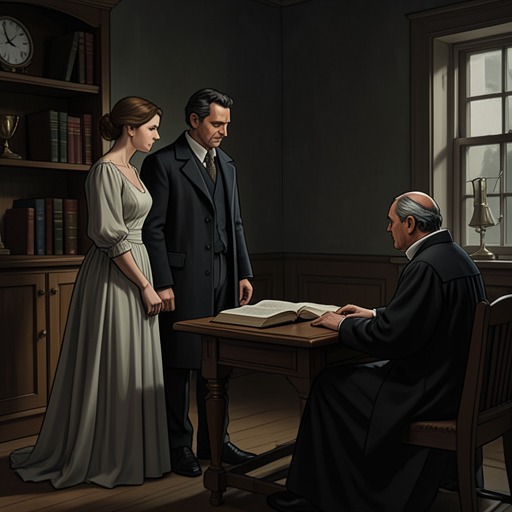
Eduviges Dyada
Pedro PáramoEduviges Dyada is Juan Preciado’s first host in Comala and one of the voices through which its past breaks into the present. She welcomes him as if she has been expecting him, then recounts her friendship with his mother, Dolores Preciado, and episodes involving Inocencio Osorio, Miguel Páramo, and Toribio Aldrete. Her house offers shelter, but its dark rooms also open onto a village where violence, memory, and the dead remain unnervingly close.
Identity and Introduction
Eduviges introduces herself at the threshold and invites Juan inside. She says everything is ready and leads him through a long sequence of dark, apparently deserted rooms. As his eyes adjust, the passage becomes visible: it runs between bundles piled on either side. The house is at once a place of welcome and a space whose contents and boundaries are not immediately clear.
Her welcome is strikingly well timed. Eduviges says Dolores warned her that Juan would arrive that very day. Juan has not told her his mother’s name, and he is astonished that she knows it. The explanation establishes Eduviges as more than a stranger offering lodging: she has a connection to Dolores that survives their separation and, as the conversation makes plain, even death.
Friendship with Dolores Preciado
Eduviges describes herself and Dolores as very close when they were young. Dolores had only just married, and Eduviges remembers her as beautiful and tender, someone easy to love. Yet Dolores never told Juan about her friend. Eduviges registers that silence as curious rather than hostile, placing their intimacy in a past that did not become part of Juan’s knowledge of his mother.
The two women had promised to die together, so that they could encourage one another on the journey beyond life if they met difficulties. Dolores died a week before Juan’s arrival, leaving Eduviges to speak of her as someone who has gone ahead. The promise gives their friendship an unusual afterlife: Eduviges imagines death not simply as an ending but as a passage they had meant to undertake side by side. She says she will catch up with Dolores, and speaks of death as something a person might hasten rather than merely await. She also tells Juan she regards him as her own son, saying that Dolores’s son should have been hers, though she postpones explaining why.
Stories of Desire and Violence
Eduviges recalls Inocencio Osorio, who broke horses at Media Luna and was nicknamed Ricochet for his agility. Pedro Páramo praised his ability to tame a horse with his hands in his pockets. But, in Eduviges’s account, Osorio had another occupation: he acted as an instigator of dreams, using supposed healing to manipulate women. He claimed to offer a laying on of hands, touching and rubbing their bodies while speaking about their futures, invoking supernatural forces, and sometimes stripping under the pretense that women wanted it. Eduviges says he deceived both Dolores and herself. Her account exposes how a performance of spiritual authority could disguise sexual exploitation.
Osorio’s influence on Dolores had a concrete consequence. He warned her not to join with a man on a night when the moon was unfavorable. The episode links the fortune-teller’s theatrical claims to the choices and anxieties surrounding Dolores’s marriage, without reducing Eduviges’s memory to mere gossip: she speaks as someone who also experienced his advances.
Eduviges also recounts the night of Miguel Páramo’s death. She says his horse passed toward Media Luna at an hour when Miguel would ordinarily have been returning much later from visiting his lover in Contla. After hearing the horse, she thought someone knocked at her window and found Miguel there. He told her he had been unable to reach the town: fog, smoke, or something similar had obscured the way, and he thought he might have passed Contla. Eduviges presents this as the beginning of her knowledge of what happened that night, while allowing that some sounds might have been imagination. Her account makes the boundary between an actual encounter and a spectral one deliberately uncertain.
The House and Comala’s Dead
Another room in Eduviges’s house is associated with Toribio Aldrete, who was hanged there long ago. The door was then sealed until his body had dried, so that he could not find rest. When Juan says the cries in his room kept him awake, Damiana Cisneros explains the history and insists that no key opens the door. Juan says Eduviges had given him that room as the only one available. The exchange makes her hospitality part of Comala’s darker geography: the room she offers is marked by an unresolved death, and the means by which Juan entered it cannot be accounted for.
Eduviges’s story belongs to a wider world of voices that persist after the living have vanished. Damiana describes echoes seemingly shut inside walls and stones, including voices clear enough to be recognized. On a funeral procession she says she encountered her sister Sixtina, who stepped away from the others and asked her to pray. In this setting, Eduviges’s communication with Dolores is not an isolated marvel but one instance of the dead remaining present through speech, requests, and remembered ties.
Narrative Role and Significance
Eduviges’s welcome gives Juan access to Comala, but her stories also unsettle the distinction between guide and ghost, recollection and encounter. She knows of his arrival through Dolores, remembers Miguel’s impossible journey, and offers a room tied to a man denied rest. Her home becomes an early lesson in how the town’s past inhabits its present.
Juan later explains that he was found dead in the plaza, and that the murmuring voices gathered around him until his soul froze with fear. He had come seeking Pedro Páramo, guided by illusions. That revelation sharpens the significance of Eduviges’s opening hospitality: she receives a visitor who is already moving through a world of the dead, though the full meaning of that condition emerges only later. Through her, Comala’s history is not delivered as a settled account but as intimate testimony, marked by affection, exploitation, uncertainty, and the persistence of voices that cannot simply be silenced.